5StarsStocks.com publishes stock-market research, sector guides and investing-style articles, from AI and cannabis to dividend, value and blue-chip shares. Its stock ideas are not a trading service or a substitute for independent analysis. This 2026 review explains what the website covers, what its ratings can—and cannot—tell you, and how to interpret searches for the “best stocks to buy now” without mistaking marketing for guaranteed financial outcomes.
Table of Contents
What is 5StarsStocks.com?
5StarsStocks.com is a financial-content and stock-idea website that organises publicly traded companies by industry and investing style. Its homepage describes research into company fundamentals, competition and market developments, and its navigation covers stocks, market commentary, investing education and sector-based research. The name refers to the publisher’s presentation of stock ideas, not to a universally recognised exchange rating or regulator-issued score.
The distinction is important for newcomers: reading a stock list is not the same as opening a trading account. The site’s own disclaimer says stock investing can lose money and its material is not personalised financial advice. To trade shares you would need an appropriate licensed brokerage separately. This independent review explains how to interpret the material and where its limits lie. Readers can check the publisher’s latest pages at the official 5StarsStocks.com website before relying on any older search result.
For a separate look at investment-related business models, Tech CEE’s company history guide offers background on how corporations have evolved; it is not an endorsement of any stock featured by 5StarsStocks.com.
How the website works and what a five-star rating means
The public website is organised around sectors such as technology and healthcare and styles such as growth, value, dividend and blue-chip investing. Readers can explore editorial lists and articles, then investigate particular companies. A five-star label is a site-specific research or promotional classification; it is not equivalent to a guaranteed return, exchange certification or a published independent analyst consensus.
The homepage speaks about financial statements, competitive landscapes and macroeconomic developments. However, the available public material does not establish a complete auditable formula showing the weight of each input, rebalance dates, test period and treatment of failed picks. Claims that a system uses artificial intelligence likewise require independent documentation of the actual models and their performance.
An informed user checks the latest company filings, revenue quality, debt, valuation, share dilution and trading liquidity rather than translating any rating directly into a buy order.
Is 5StarsStocks.com reliable and who runs the research?
Reliability has several dimensions: a website can be live and publish real articles while its forecasts remain unproven. The site displays articles attributed to Anthony Walker and describes a research team, but publicly visible biographies, institutional ownership details and audited long-term performance evidence remain limited in the sources examined. A byline is not automatically proof of professional licensing or independently verified expertise.
Third-party reviews repeat conflicting accuracy percentages. Without the underlying dated stock calls, prices, dividends, transaction costs and reproducible test method, it would be misleading to claim that the service achieves a confirmed 70%, 35% or any other universal success rate. Investors should also distinguish a regulator’s public investor education from an endorsement of a specific publisher.
For broader website-assessment habits rather than a direct connection to this company, read Tech CEE’s online credibility checklist.
5StarsStocks.com AI: technology shares and model claims
Searches for 5starsstocks.com ai usually lead to coverage of artificial-intelligence companies and potentially AI-assisted analysis. These are different subjects. An AI stocks category can include software, semiconductor, cloud infrastructure and enterprise automation providers, each with distinct business economics.
Investors comparing these companies should review the proportion of revenue actually tied to AI demand, margins, capital spending, customer concentration, competitive threats and valuations. A strong technology trend does not guarantee that every related stock will perform well; future growth can already be priced into the shares.
Tech CEE’s Anthropic stock guide discusses a separate question about a private AI company and public-market access. The link is for context and does not imply an association with 5StarsStocks.com or establish any share recommendation.
5StarsStocks.com healthcare and cannabis stocks
5starsstocks.com healthcare covers a broad landscape that can include pharmaceuticals, biotechnology, medical equipment, managed care and health services. Revenue drivers and risks differ sharply: a mature medical-device manufacturer depends on sales execution, while an early biotechnology company may depend on a single clinical result or regulatory decision.
5starsstocks.com cannabis refers to a much narrower, often volatile industry. Legal frameworks differ across jurisdictions, and operators can face financing restrictions, taxation, pricing competition and dilution. Headlines about expanding markets do not establish that a particular company can generate durable free cash flow.
Check the company’s own filings, clinical or regulatory disclosures where relevant, liquidity and financing runway. A high-growth narrative without access to capital can quickly become a high-risk holding.
Consumer staples: how defensive are these stocks?
The phrase 5starsstocks.com staples points to companies selling frequently purchased goods such as groceries, household items and personal-care products. Recurring demand can make some companies comparatively resilient in weak economic periods, but margins can still be squeezed by input costs, wage increases, retailer bargaining power and changes in consumer preferences.
When comparing staples stocks, examine pricing power, unit volumes, cash conversion, debt, dividend coverage and the price being paid for predictable earnings. A business may be financially stable while its shares are expensive. “Defensive” should never be confused with risk-free.
The difference between resilient demand and guaranteed profits illustrates why the best research considers the business and its valuation separately.
Materials, nickel and lithium: cyclical investment themes
5starsstocks.com materials, 5starsstocks.com nickel and 5starsstocks.com lithium relate to miners, processors, chemicals producers and other companies exposed to raw materials. Metal prices fluctuate with supply additions, industrial demand, inventory cycles, policy changes and production disruptions; a promising battery narrative does not eliminate commodity-cycle risk.
Nickel businesses can have different cost structures depending on ore grade, energy prices, processing technology and environmental obligations. Lithium producers may face sharp changes in realised prices, expansions by competitors and financing requirements for new projects. Some diversified materials companies are less dependent on one metal but bring other exposures.
Before interpreting a site ranking, compare reserve quality, jurisdiction, production cost, balance-sheet headroom, project permitting and the commodity-price assumptions in a company’s own reports.
Defense and military stocks: what is the overlap?
The searches 5starsstocks.com defense and 5starsstocks.com military generally describe companies selling aircraft, electronics, cybersecurity, logistics and other equipment or services to defense customers. A firm can have long contracts yet face budget cycles, contract delays, cost overruns and customer concentration.
Military spending headlines do not tell investors how much profit any individual supplier will earn. Important questions include contract type, backlog quality, export restrictions, production capacity and whether expected orders are already reflected in market valuations.
Readers should also separate weapons manufacturers, dual-use software providers and general industrial suppliers rather than assuming every name in a defense sector list carries the same financial and ethical profile.
3D printing stocks: innovation versus commercial demand
5starsstocks.com 3d printing stocks can cover machinery providers, printing materials, design software and specialised manufacturing services. Additive manufacturing is useful in areas such as prototyping, medical applications and industrial parts, but business performance varies widely by application, scale and customer adoption.
Research should ask whether the company has repeat orders rather than only pilot projects, how consumables contribute to margins, whether operating cash flow supports investment and how easily competitors can replicate its products. A compelling demonstration does not automatically translate into profitable large-scale manufacturing.
As with AI, the important distinction is between an interesting technology and a security offered at an attractive risk-adjusted valuation.
For a separate discussion of emerging technology financing rather than a stock recommendation, Tech CEE’s BlockDAG technology article provides context about another high-volatility subject.
Blue-chip stocks and long-term stability
The term 5starsstocks.com blue chip typically points to shares of established, widely recognised companies. Such firms often have substantial revenue, established distribution and access to capital, but they still face changing competition, industry disruption and valuation risk. A familiar brand is not a guarantee against falling prices.
Compare earnings quality, debt maturity, capital-allocation decisions and the sustainability of any dividend. It is also useful to consider concentration: a portfolio of several famous companies may still be heavily exposed to the same technology sector or economic factor.
Tech CEE’s business consulting overview offers separate background on how organisations make strategic decisions; it is not an equity analysis or endorsement of particular blue-chip shares.
Value stocks versus growth stocks
5starsstocks.com value stocks groups securities that investors may consider inexpensive relative to fundamentals, often using price-to-earnings, price-to-book or cash-flow multiples. A low ratio can indicate opportunity, but it can also reflect shrinking profits, weak governance or structural decline. Always examine why the shares appear cheap.
Growth stocks generally command attention for expanding sales, earnings or addressable markets. Rapid growth may justify a higher valuation, but optimistic forecasts can disappoint. A useful comparison includes future cash flows, dilution, reinvestment needs and the range of possible outcomes rather than a simple “cheap versus expensive” slogan.
Different styles can lead at different stages of the market cycle. No website rating removes the need for an investment horizon and a sensible price.
Dividend stocks and income stocks
The keywords 5starsstocks.com dividend stocks and 5starsstocks.com income stocks relate to shares held partly for cash distributions. Dividends can support an income strategy, but payment amounts are generally not guaranteed. Boards may reduce or suspend them when earnings, debt covenants or cash requirements change.
A very high dividend yield is sometimes a warning that the share price has fallen because investors expect a cut. Review payout ratio, free cash flow, debt, reinvestment obligations and dividend history alongside the yield. Total return includes both distributions and changes in share price.
For a different perspective on financial news claims and volatility, Tech CEE’s crypto market news overview shows why past performance and attractive headlines should be interpreted cautiously; it is not a dividend-investing service.
Passive stocks and the difference from passive investing
5starsstocks.com passive stocks is a potentially confusing label because passive investing usually refers to a strategy, such as using an index-tracking fund, rather than a formal category of individual companies. A person can own one stock for many years, but that does not automatically make the portfolio diversified or index based.
Passive approaches often emphasise broad exposure, fees, recurring contributions and a long investment horizon. Individual stock picking requires company-specific due diligence, even when the intention is to hold for years. Narrow thematic funds also may not deliver the diversification suggested by the word “passive.”
Tech CEE’s startup tools guide covers a separate kind of long-term planning and budgeting; it should not be mistaken for a recommendation of passive securities.
5StarsStocks.com stocks to buy, best stocks and buy now searches
Phrases such as 5starsstocks.com stocks, 5starsstocks.com to buy, 5starsstocks.com best stocks and 5starsstocks.com buy now signal a reader looking for an immediate decision. A publisher’s article may offer a candidate watchlist, but without a current date, valuation and specific risk assumptions, it cannot establish that a security suits every investor today.
Stock prices and fundamentals change after publication, and old lists may remain searchable for years. Check the original article date, the latest issuer filings, material events and whether any valuation assumptions still hold. Confirm that a ticker and exchange refer to the intended security and that the instrument’s liquidity is adequate.
There are no guaranteed “best” picks for all people. Goals, time horizon, tax rules, financial circumstances and risk tolerance should govern what research comes next.
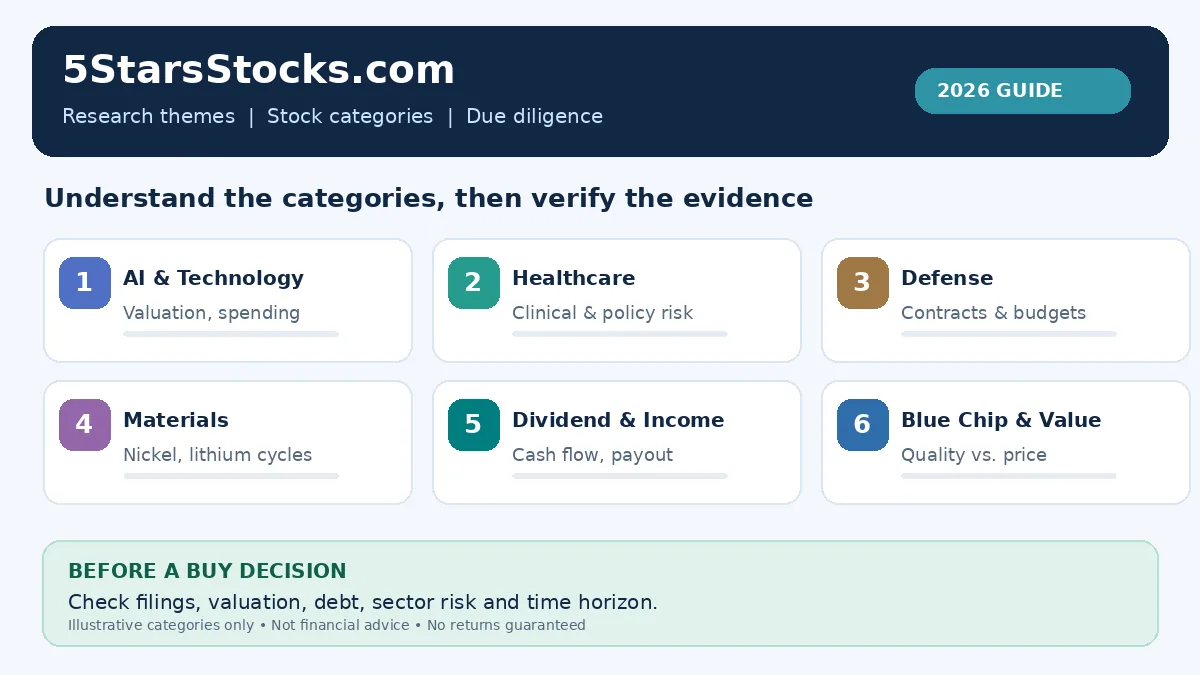
A practical 5StarsStocks.com research checklist
First identify the exact company and exchange from the publisher’s article. Second read the latest official earnings announcement, annual report and risk factors. Third compare revenue, profitability, free cash flow and debt over multiple periods. Fourth examine competitors and identify what the market appears to expect. Fifth run a simple downside scenario instead of looking only at the optimistic case.
Next, determine whether an attractive dividend or valuation is supported by cash generation. Compare the candidate with alternatives, including broad diversified funds, rather than studying it in isolation. Record your rationale and review it if new evidence emerges.
For more on distinguishing trustworthy websites from promotional claims, Tech CEE’s SparkPressFusion website review provides unrelated editorial-verification context.
Fees, analyst transparency and risk warnings
Before paying for a newsletter or research product, verify the current subscription price, trial rules, cancellation policy and who is responsible for the analysis. The public material checked did not establish a single consistent, verified 2026 paid price or independently audited record of returns. Do not assume figures quoted in third-party reviews remain accurate.
Investor.gov, the U.S. Securities and Exchange Commission’s investor education resource, explains that stocks can lose value and that diversification helps manage rather than eliminate risk. Its investor-protection guidance also warns against AI systems marketed as guaranteed winners. These principles remain valid regardless of which website supplies an investment idea.
For an independent discussion of how financial narratives spread online, Tech CEE’s Yonopress digital publishing review offers background on editorial sites, not a financial recommendation.
The Quicklinks guide explains safe navigation to official resources, a separate topic from choosing an investment research provider.
Frequently asked questions
What is 5StarsStocks.com and can I buy shares there?
It is a stock-research and financial-content website presenting sector and investment-style ideas. Its public pages do not establish a brokerage or direct trading service. Buying securities normally requires a separate authorised brokerage account.
Are 5StarsStocks.com five-star ratings independently verified?
The site describes a research-driven process, but an independently audited, reproducible long-term accuracy record and full public scoring formula were not established in the sources reviewed. Use the ratings as ideas to examine, not promises.
Which sectors does 5StarsStocks.com cover?
Its homepage lists categories including AI and technology, healthcare, cannabis, consumer staples, aerospace and defense, materials, blue-chip, dividend, value and other styles. Searches also target nickel, lithium and 3D printing. Coverage of a topic is not proof that any particular stock is a sound purchase.
Should I follow 5StarsStocks.com buy-now lists?
Not without checking current prices, official company filings, valuation, risks and your own financial circumstances. An old article or high rating cannot establish an appropriate purchase for every reader, and losses are possible.
Final verdict on 5StarsStocks.com
5StarsStocks.com can be a useful place to discover stock-market vocabulary and sector ideas, particularly for readers sorting through AI, defense, materials, healthcare and dividend themes. Its editorial ratings and lists should be treated as starting points, not authenticated investment advice or a mechanism for placing trades.
The most reliable approach is to cross-check the facts with issuer disclosures and official investor education, think through losses as well as upside, and seek a suitably qualified adviser where decisions are material. This independent guide reflects public information checked in October 2026 and does not recommend purchasing any particular security.
About the Author